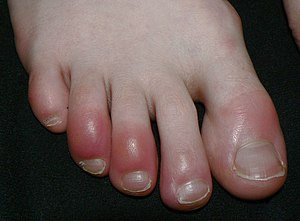
Chilblains

- Image via Wikipedia
Chilblains are associated with cold winter conditions, often worsened by wet weather.
So as I go off to the Cape for a few days I'll give you some suggestions to protect against 'winter feet'.
Chilblains affect all age groups and both sexes, but girls and women do seem to suffer more.
Keep your feet warm and dry. Avoid socks with synthetic fibres, that can make your feet sweaty and cold.
Some modern fibres 'wick away' sweat, but you can get cold. Try a pair of mohair socks – Visit the Cape Mohair website.
If you are sitting for some time, try wrapping your legs in a loose-fitting blanket(think of the bottom of a sleeping bag).
Do wriggling and waggling exercises to keep the circulation moving in your leg muscles. Don't sit for long periods, because if you have a sluggish circulation it makes it worse.
STOP SMOKING! The spasm or constriction of your blood arteries from ONE cigarette lasts 6 hours.
Take regular walks in well-fitting shoes. Tight shoes press the blood out of your toes. Thicker sole are important to protect your feet from the cold and wet. Boots are good but high fashion ones often don't keep your feet warm.
Chilblains are the result of a defective response to a cold stimulus. For example: when you take the chicken out of the deep freeze, the nerves in your fingers send and receive a message which causes the nerves to the blood vessels to shut down to protect the fingers from the cold.
When you have the chicken out on the kitchen worktop and you are back in the normal temperature the reverse messages happens, and you get a bit of a tingling feeling as the blood flow returns to normal.
If this system has a delayed response – for whatever reason – the fingers remain cold, because the blood is lacking oxygen. Soon the body recognises this as abnormal and tries to fix it with an inflammatory response.
This can settle things with just a little swelling and pain in the fingers, but usually this process ends up with red, painful, swollen fingers, which look like cocktail sausages.
In some cases, this process is the result of a significant vascular disease, for example – Raynauds Syndrome(or Phenomenon). If you suffer from this you will know and should be havinr treatment – it is characterised by spontaneous spasm of the blood vessels of the hands – where you get an unexpected cold finger or fingers, at any time of year, but especially in winter.
Treatment for chilblains is difficult and usually centres around prevention. Shoes, socks and footwear as I have said.
There are some medicines prescribed by doctors called Vaso-dilators, but often topical preparations such as Thrombophob or Reparil Gel are tried.
Some Homeopathic preparations include Vitamin A and Nicotinic Acid which act as circulatory stimulants. Getting into a warm bed helps – but don't sleep with your feet up against a hot water bottle!
As I write this in Hout Bay, I'm happy to report that it has been a beautiful sunny and dry day.
Take care of your pair. No more smoking. Regular exercise. Keep chilblains away this winter.
Leave a Comment


![Reblog this post [with Zemanta]](http://img.zemanta.com/reblog_e.png?x-id=c24ce6db-0ad2-458b-953f-1097c11ebe83)
Comments on Chilblains
Hi
Thanks for the info on chilblains. I live in PMB & suffer from chilblains for a number of years…
This winter, I kept my feet warm from the start. However, chilblians still came up. I find that keeping them warm is more irritable to them…
Does that make sense?
The temperature here in PMB drops to anything between -1 & 5 degrees. The days are warm – above 20 degrees. In the mornings, I pop out for about 10min or less, but make sure my hands & feet are warm. The houses & buildings remain very cold despite the warm sunny days.
What will the best treatment be? Right now, I don't have any socks on. My feet don't feel cold but toes are getting itchy.
Thanks.
Hi Geeta
Keeping warm and dry is essential and you seem to be managing that. There is a gel you can buy at the pharmacy called Thrombophob which you apply daily. Alternatively, try to get over the counter products from the pharmacy with Nicotinic Acid in them to stimulate the circulation. Don't be afraid to exercise regularly, it does help. Try to wear socks which are mainly cotton and go up your leg to the calf, but not with tight elastic. Remember to look up Cape Mohair on-line.
Inside the house avoid thin slippers, go for thicker soles and lamswool/fur ankle length. Also wear long pants that are of a fleecy material. Another thing is wear a hat! Normally your hair keeps you warm, additional covering should help.
If the chilblains are really severe – e.g. your toes swell up like small sausages and you are in pain, then I think you shoul discuss with your GP whether you should a vascular specialist.
Regards
Andrew
Thanks for the tips
. I already follow them. Sometimes I wear ankle socks over my knee-length socks. If I do not get the Cape Mohair socks can I use thermal socks?
I am 32 & fairly active, gym 3-4 times a week & do 2 or 3 yoga stretches in the mornings & evenings. I am vegetarian, don't consume alcohol or smoke. My hands & feet remain cold even in summer
I read elsewhere on the internet that Zambuk helps. I applied it. During the day it was fine, but last night I had to get up as my toes were hot & itchy. Well, it is hard to explain the sensation… The baby toe on my right foot looks like a very red sausage that has been stumped (lol, I have tiny feet & toes)
Again I am wondering if I am keeping my feet too warm.
I will try the Thrombophob & things to improve circulation
One more question: is chilblains hereditary? I learnt on Sunday that my uncle suffers from chilblains also – he is in his 70's & all his fingers are affected. His sister also suffers with it. My siblings don't have it though.
Many thanks
Hi Geeta
I think that you probably have the condition Raynaud's Disease. For peace of mind, you should make an appointment with a Vascular Specialist, for a check up, although you sound like a healthy person!
Thermal socks are perfectly OK.
There is a product called Restin which you can buy over the counter which may help, also, you could consider talking half a Disprin every day.
Your poor circulation could be hereditery, from what your Grandad has experienced.
regards
Andrew
Thanks. I have read up on Raynaud's Disease. Although I do not think I have it (more a case of severe chilblians), I will go for a check-up to my homeopath.
I am happy to say that the symptoms of redness & itchiness have subsided considerably on all my toes. That day I couldn't manage to go the pharmacy. I remembered having a calm cream used for burns, itchiness, etc & thought I would use that in the interim. I applied that together with Zambuk – and it provided relief. I am still applying both two times a day – after showering in the morning & evening. It is definitely helping.
I will ask my doctor about the suggestions you have kindly mentioned. Thanks again! Keep warm
thanks for the advice, seems to work, i am a 27 year old and only developed this condition since last winter although i have always had cold hands and feet, i have 1 question though, why should i not sleep with my feet against the hot water bottle? i usually do this as i cannot use an electric blanket, it gives me hives. thanking you once again.
Yasmeen, as you have experienced, a poor circulation can pre-dispose you to chilblains. If the poor circulation is identifiable as Raynaud's Syndrome, then a chilblain type response is possible all year round.
The main reason NOT to sleep with your feet up against, or wrapped around a hot water bottle, is the risk of overheating and possibly burning them. The local response is to heat is to deliver a lot of inflammatory products to the feet. They swell a little, get sweaty trying to lose heat, then they might get cold as the night goes on when the water cools. This is why we advise warm, dry conditions and using the hot water bottle to heat the bed rather.
Andrew.